Updated November 2026 — verified tips for choosing an instrument for children at Japan Piano Center.
Weighted keyboard – why is it important for a child?
When parents buy the first electric piano for their child, they quickly encounter terms such as weighted keyboard / weighted keys, hammer action, graded hammer, GHS, GrandTouch-E, GrandTouch-S and similar.
At first glance, it may seem like these are just technical details. However, the feel of the keys is one of the most important features of an electric piano – especially if the child is learning piano at a music school.
Why? Because when a child learns, they are not just learning, which keys to press, but also how to press them..
This is where the quality of the keyboard becomes very important.
What does a weighted keyboard even mean?
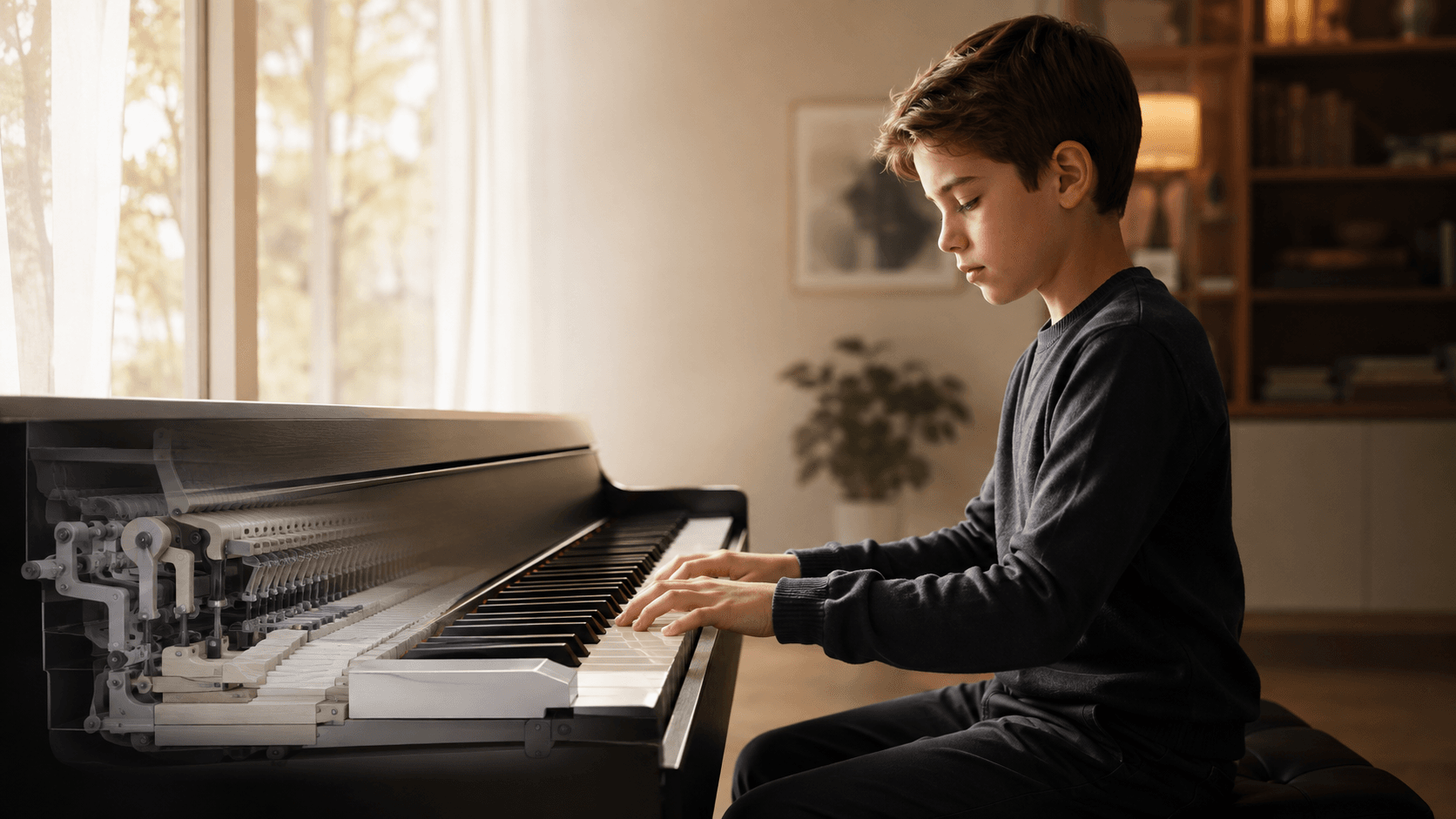
In an acoustic piano, a key is not just a switch that triggers sound.
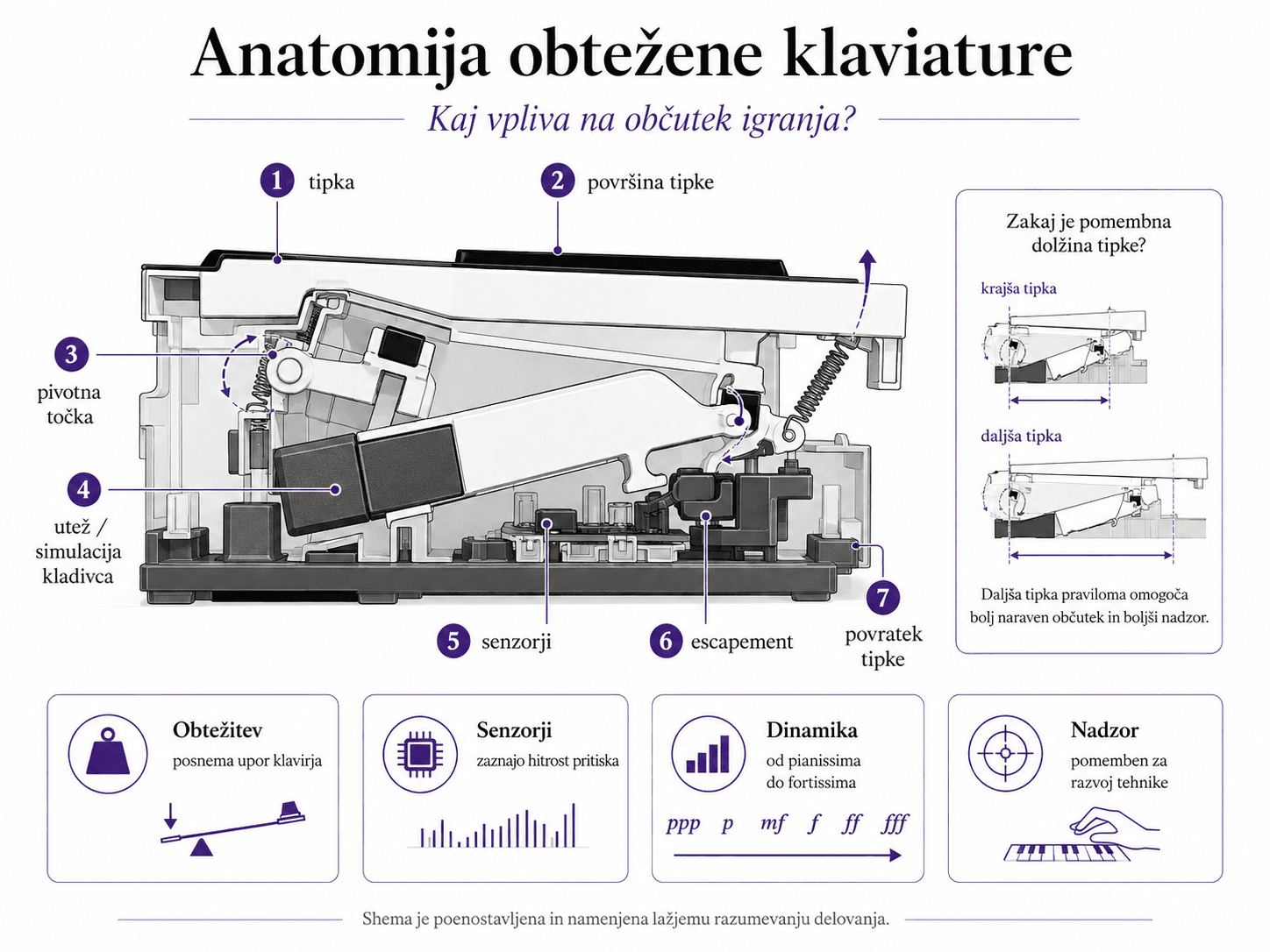
When a pianist presses a key, they move a hammer through a mechanical system that strikes the string. Therefore, we feel mechanical resistance and the movement of the entire piano mechanism under our fingers.
In an electric piano, there are usually no strings and hammers, so the manufacturer must recreate that feel with a mechanism under the keys.
Such keyboards are usually referred to as weighted or piano keyboard or hammer-action keyboard..
A good electric piano therefore does not just try to imitate the the sound of the piano, but also the feeling of playing it.
Weighted keyboard is not the same as semi-weighted
There are several different types of keyboards on the market, so the label »88 keys« alone does not mean that the instrument is suitable for learning piano.
Non-weighted keyboard
The keys are light and have a feel similar to many electronic keyboards.
Such a keyboard can be excellent for certain types of music, production, or playing synthesizers, but it is generally not the best choice for a child who wants to learn piano technique.
Semi-weighted keyboard
The keys offer a bit more resistance, but the feel is still not comparable to piano hammer-action mechanics. Such keyboards are often found in MIDI keyboards, synthesizers, and some stage instruments.
Weighted hammer-action keyboard
In this type of keyboard, the mechanism is designed to replicate the feel of an acoustic piano as closely as possible. For a child attending piano lessons or music school, it is generally most sensible to look for a 88-key hammer-action keyboard.
Why is a weighted keyboard so important for learning?
When playing the piano, a child not only develops memory and a sense of melody.
It develops a very precise connection between:
- fingers,
- hands,
- brain,
- hearing
- with the instrument's response.
When a child presses a key, they must gradually develop a sense of how to play the key to achieve the desired sound. If they play it gently, they should get a soft tone. If they play it more assertively, the tone should be louder. This is called dynamics.
And dynamics is one of the fundamental elements of playing the piano.
What happens if a child practices on a lightweight keyboard at home?
Imagine a child who practices every day at home on a small electronic keyboard with very light keys.
They can easily play a piece on it. Then they go to music school and sit down at an acoustic piano. The keys are heavier. Their action is different. The instrument's response is different. Suddenly, they have to use a quite different touch for the same result.
They may know the piece, but their sense of the instrument no longer matches that of the one they practiced on at home.
This can make it difficult to control dynamics, maintain evenness in playing, execute faster passages, articulate correctly, and overall confidence in playing.
Why are 88 keys important?
In addition to a weighted keyboard, it is recommended that the instrument has 88 keys. 88 keys, which is the same number of keys as a standard modern acoustic piano.
For a complete beginner, it may seem that a child won't need all these keys for a long time. This is often true. However, as they progress, the musical range of pieces increases.
An instrument with 88 keys therefore does not limit the child and allows them to progress on the same instrument for many years.
When purchasing an electric piano for music school, a combination of 88 keys + weighted piano action is a very good starting point.
Are all weighted keyboards equally good?
No. And this is very important when buying an electric piano.
The label »88 weighted keys« alone does not mean that the instrument will behave under the fingers like a quality acoustic piano.
Keyboards differ in:
- key weight,
- method of weighting,
- length of key lever,
- key return speed,
- sensors,
- note repetition,
- materials,
- playing feel deeper towards the inner part of the key
- and many other details.
Therefore, two digital pianos that both have »88 weighted keys« on paper can play completely differently. A good example is the different keyboards that Yamaha uses in its digital pianos.
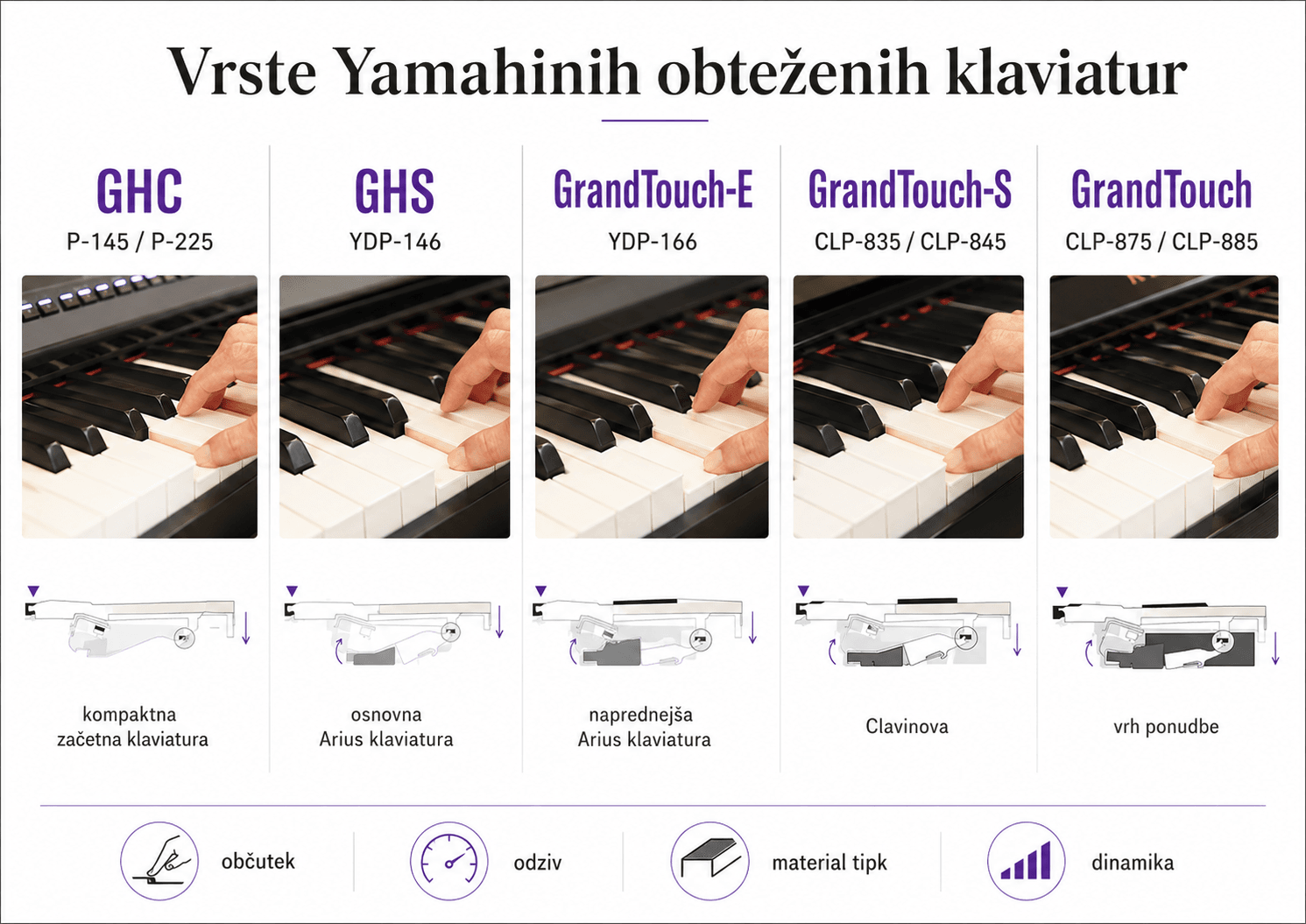
Yamaha GHC, GHS, GrandTouch-E, GrandTouch-S, and GrandTouch – what is the difference?
Looking at Yamaha's current offerings, we can clearly see how the keyboard evolves from basic portable digital pianos to high-end Clavinova and AvantGrand models.
It is important to emphasize that the following classification is not an official Yamaha »quality scale«, but a simplified guide to better understand the differences between individual mechanisms.
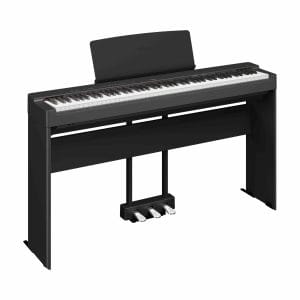
1. GHC – Graded Hammer Compact
GHC or Graded Hammer Compact is Yamaha's compact hammer-action keyboard with 88 keys.
For example, we find it in models:
GHC was developed to provide a weighted piano feel in a much more compact housing.
Yamaha states that the GHC, despite its smaller construction, maintains a weighted keyboard feel comparable to the GHS used in previous P-series models.
Who is the GHC suitable for?
Primarily for:
- beginners who do not attend music school,
- users who need a portable instrument,
- and situations where we want a real electric piano in the most compact housing possible.
For a beginner, this is a significantly more suitable foundation for piano education than a regular unweighted electronic keyboard, although it is advisable to choose better models for starting in music schools.

2. GHS – Graded Hammer Standard
GHS or Graded Hammer Standard is one of Yamaha's most well-known weighted keyboards.
In the current generation of Arius, it is used by:
The YDP-146 has all 88 keys with GHS mechanics. In the new generation, Yamaha has also improved the design of the sensors. According to the manufacturer, more accurate detection helps with fast note repetitions and more complex passages. This is important, as the new YDP-146 is not just the YDP-145 with a new model number..
Who is the Yamaha Arius YDP-146 suitable for?
The YDP-146 is particularly interesting for:
- a beginner,
- a child in music school,
- a family that wants a classically designed home electric piano,
- a user who wants three pedals.
- and a buyer looking for a good balance between price and piano usability.
Although GHS is a more basic mechanism in Yamaha's offering, it does not mean it is a »bad keyboard«.
It is a true weighted piano mechanism, also intended for learning.
Although GHS is a more basic mechanism in Yamaha's offering, it does not mean it is a »bad keyboard«. It is a true weighted piano mechanism, also intended for learning.


3. GrandTouch-E™ – a significant step forward in the new generation of Yamaha Arius
This brings us to one of the biggest innovations of the current generation of Arius.
New:
use a completely new GrandTouch-E™ keyboard. Yamaha introduced the new generation YDP-166, YDP-146, YDP-S56, and YDP-S36 in June 2026. The YDP-166 and YDP-S56 feature the new GrandTouch-E mechanism, while the YDP-146 and YDP-S36 use GHS.
GrandTouch-E in the YDP-166 offers:
- 88 weighted keys,
- a key surface made of synthetic ebony and ivory,
- Escapement
- and a mechanism designed for better response in various playing styles.
What is escapement?
In an acoustic concert piano, the pianist feels a very subtle change in resistance when pressing the key slowly, related to the mechanism's action just before the hammer is released. In digital pianos, higher-quality keyboards can simulate this feeling.
For a complete beginner, this may not be the most important feature of the instrument, but as the pianist progresses, such details become more significant.
YDP-146 or YDP-166 – what do we actually gain?
This is a very good comparison for parents buying an instrument for their child.
On paper, both have:
- 88 weighted keys,
- Yamaha CFX klavirski zvok,
- tri pedale,
- 192-glasno polifonijo,
- VRM Lite
- in obliko klasičnega domačega pianina.
Toda pri občutku igranja je med njima pomembna razlika:
YDP-146 → GHS
YDP-166 → GrandTouch-E™
Če otrok šele začenja in iščemo kakovosten prvi domači klavir, je YDP-146 zelo smiselna izbira.
Če pa že vemo, da bo otrok klavir igral resneje in želimo instrument kupiti za daljše obdobje, je YDP-166 zaradi naprednejše GrandTouch-E klaviature zelo zanimiv korak naprej.
Pomembno je omeniti tudi prejšnjo generacijo: YDP-165 je uporabljal GH3 klaviaturo. Novi YDP-166 pa je prešel na novo GrandTouch-E mehaniko.
4. GrandTouch-S™ – vstop v višji razred Clavinova
Nad serijo Arius pridemo do Yamaha Clavinova CLP-800.
Tu Yamaha uporablja klaviature GrandTouch-S and GrandTouch.
GrandTouch-S najdemo med drugim v modelih:
Vendar tudi med njimi obstaja pomembna razlika.
CLP-825 in CLP-835 uporabljata GrandTouch-S klaviaturo s sintetično površino ebenovine in slonovine ter escapementom. To je že precej bolj izpopolnjena klavirska mehanika, ki je namenjena natančnejšemu nadzoru dinamike in dotika.
Yamaha pri aktualni CLP-800 seriji poudarja tudi optimizirano obtežitev kladivc GrandTouch-S mehanike za boljši odziv klaviature.
Za otroka oziroma učenca, ki se želi klavirja učiti resno in dolgoročno, je to že zelo zanimiv razred instrumentov.
Pri modelu Yamaha CLP-845 and CLP865GP naredimo naslednji korak:
GrandTouch-S + lesene bele tipke + sintetično površino ebenovine/slonovine + escapement.
Ali lesene tipke avtomatično pomenijo boljšo klaviaturo?
Ne. Samo material tipke še ne določa kakovosti celotne mehanike. Lesene bele tipke so del celotne naprednejše GrandTouch-S konstrukcije, zato jih je smiselno gledati kot del sistema, ne kot samostojno lastnost.
The following are also important:
- geometrija tipke,
- vzvod,
- obtežitev,
- senzorji,
- stabilnost mehanizma
- in način, kako tipka reagira skozi celoten hod.


pridemo do polne GrandTouch™ klaviature. Ena pomembnih razlik v primerjavi z GrandTouch-S je daljša vzvodna oziroma pivotna razdalja.
Zakaj je to pomembno?
Pri igranju ne pritiskamo vedno samo na sprednji rob tipke. Pri določenih akordih oziroma položajih rok moramo tipko zaigrati precej bližje njenemu zadnjemu delu. Daljši vzvod omogoča bolj enakomeren in naraven občutek tudi tam.
Yamaha pri GrandTouch klaviaturah višjih modelov CLP-serije navaja najdaljšo pivotno razdaljo, ki jo je podjetje doslej uporabilo pri svojih digitalnih klavirjih.
6. CLP-885 – dodane protiuteži
Na samem vrhu klasične pokončne serije Clavinova je:
Yamaha CLP-885.
Ta uporablja:
- GrandTouch klaviaturo,
- lesene bele tipke,
- 88-key Linear Graded Hammers,
- Escapement
- and protiuteži oziroma counterweights.
CLP-875 ima GrandTouch in 88-key Linear Graded Hammers, vendar nima dodatnih protiuteži, medtem ko jih CLP-885 uporablja.
Protiuteži pripomorejo predvsem k natančnejšemu nadzoru tipke pri nežnem igranju in k občutku, ki se še bolj približa klavirski mehaniki.
Kako bi aktualne Yamaha klaviature poenostavljeno razvrstili?
Če gledamo predvsem konstrukcijo in realističnost klaviature, lahko za lažje razumevanje naredimo naslednjo orientacijsko lestvico:
| Keyboard | Primeri aktualnih modelov | Priporočena uporaba |
|---|---|---|
| GHC | P-145, P-225 | začetnik, domača vadba, prenosni instrument |
| GHS | YDP-146, YDP-S36 | začetnik, glasbena šola |
| GrandTouch-E™ | YDP-166, YDP-S56 | resnejši učenec, dolgoročna domača uporaba |
| GrandTouch-S™ | CLP-825, CLP-835 | zahtevnejši učenec, dolgoročno klavirsko izobraževanje |
| GrandTouch-S™ z lesenimi belimi tipkami | CLP-845, CLP-865GP, P-525 | naprednejši učenec in pianist |
| GrandTouch™ + 88-key Linear Graded Hammers | CLP-875 | zelo zahtevno igranje |
| GrandTouch™ + Linear Graded Hammers + protiuteži | CLP-885 | vrh klasične pokončne serije Clavinova |
Pomembno: tabela je poenostavljena razvrstitev za pomoč kupcu in ni uradna Yamahina kakovostna lestvica.
Torej – kateri Yamaha električni klavir za otroka?
Če želimo odgovor zelo poenostaviti:
Otrok šele začenja: Yamaha P-145 / P-225 ali YDP-145 so lahko zelo dobra izhodišča. Dobimo 88 obteženih tipk in instrument, na katerem se otrok lahko pravilno začne učiti.
Otrok obiskuje glasbeno šolo in želimo instrument za dalj časa: Zelo zanimiv je Yamaha YDP-165 z GH3 klaviaturo or Yamaha CLP-825. To je korak naprej predvsem pri sami mehaniki.
Želimo kakovosten instrument za resno in dolgoročno učenje: Tu bi pogledali Yamaha CLP-835 oziroma CLP-845. CLP-845 je posebej zanimiv zaradi GrandTouch-S mehanike in lesenih belih tipk.
Otrok oziroma pianist je že zelo zahteven: Takrat pridemo do Yamaha CLP-875 ali CLP-885. Tu klaviatura ni več samo »dovolj dobra za električni klavir«, ampak je izdelana z namenom čim bolj natančnega približevanja občutku akustičnega koncertnega klavirja.
Je za začetnika potem nujen akustični pianino?
Ne nujno. Kakovostni sodobni električni klavirji so lahko zelo dobri instrumenti za začetek in nadaljevanje učenja.
Ponujajo tudi nekaj praktičnih prednosti:
- the ability to play with headphones,
- nastavitev glasnosti,
- ne potrebujejo uglaševanja,
- zavzamejo manj prostora,
- pogosto omogočajo snemanje,
- povezujejo se z aplikacijami in računalnikom.
Akustični pianino ima še vedno posebno prednost
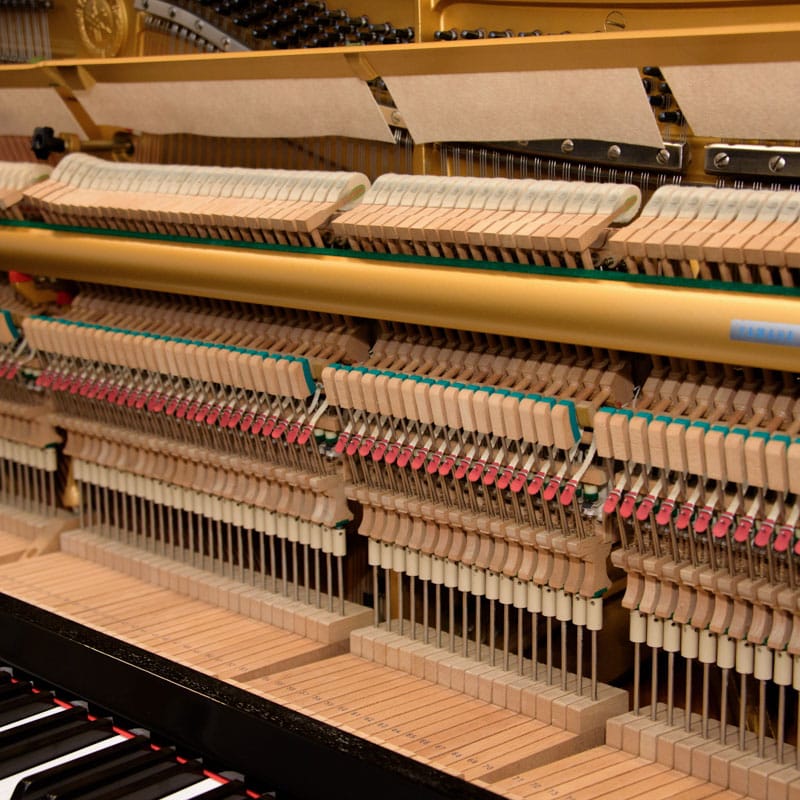
Čeprav so digitalni klavirji izjemno napredovali, je kakovosten akustični pianino še vedno referenca za občutek igranja. Pri njem je povezava med tipko, kladivcem in struno popolnoma mehanska. Pianist neposredno nadzoruje nastanek zvoka.
Zato je kakovosten akustični pianino odlična dolgoročna izbira za otroka, ki se želi klavirja učiti resneje. Po drugi strani pa je za številne družine dober električni klavir zaradi prostora, sosedov ali možnosti igranja s slušalkami precej bolj praktična rešitev.
Na kaj naj bodo starši pozorni pri nakupu?
Če kupujete prvi električni klavir za otroka, ki bo obiskoval glasbeno šolo, preverite predvsem:
1. Ima instrument 88 tipk? To omogoča uporabo celotnega klavirskega registra.
2. So tipke popolnoma obtežene? Iščite klavirsko oziroma hammer-action mehaniko.
3. Kako kakovostna je mehanika? Napis »obtežene tipke« ni dovolj. Preverite, kateri mehanizem instrument dejansko uporablja.
4. Ali klaviatura omogoča dobro dinamiko? Instrument mora natančno zaznavati različne načine igranja.
5. Kako se tipke dejansko občutijo? To je težko oceniti samo iz tehničnih specifikacij. Zato priporočamo, da instrument pred nakupom preizkusite.
6. Bo instrument primeren tudi čez nekaj let? Včasih je smiselno že na začetku izbrati nekoliko boljši model, ki ga otrok ne bo hitro prerasel.
Za še več informacij o različnih modelih električnih, akustičnih in hibrisnih klavirjev lahko pobrskate po YAMAHA spletni strani.
Naj otrok klavir pred nakupom preizkusi?
Če je mogoče – vsekakor. Eden najboljših načinov za razumevanje razlik je, da otrok oziroma starši neposredno primerjajo več instrumentov.
Na primer:
Yamaha YDP-146 → YDP-166 → CLP-835 → CLP-845 → CLP-875
Vsi so električni klavirji. Vsi imajo 88 obteženih tipk. Toda ko jih zaigramo enega za drugim, postanejo razlike v klaviaturi precej bolj razumljive.
In prav tega iz fotografije ali podatka »88 weighted keys« na spletni strani ni mogoče zares občutiti.
Niste prepričani, kateri električni klavir izbrati?
Na papirju imajo lahko Yamaha P-145, YDP-146, YDP-166, CLP-835 in CLP-845 vsi 88 obteženih tipk.
Pod prsti pa so razlike lahko zelo velike. Prav zato priporočamo, da različne modele pred nakupom preizkusite in neposredno primerjate.
V Japan Piano Center vam pri izbiri svetujemo glede na:
- the child's age,
- njegovo trenutno znanje,
- zahteve glasbene šole oziroma učitelja,
- prostor, ki ga imate doma,
- potrebo po igranju s slušalkami,
- dolgoročne načrte
- in predvideni proračun.
Naš cilj ni samo najti najcenejši ali najdražji instrument, ampak pravi klavir za konkretnega otroka – takšnega, na katerem bo z veseljem igral, vadil in napredoval še vrsto let.
Japan Piano Center – pravi instrument za prve note in vse, kar pride za njimi.
Več o izbiri med akustičnim in digitalnim inštrumentom: Piano or electric piano?